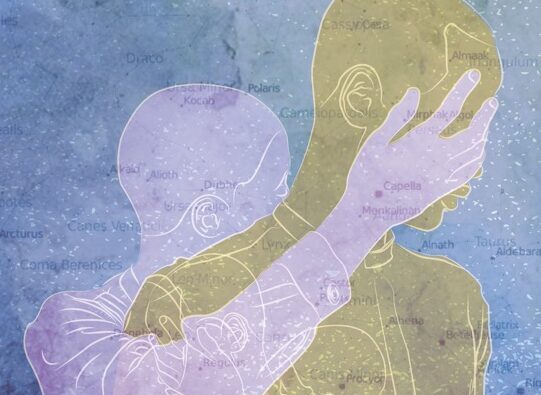
The Secret Sharer (world premiere), created and adapted by DNAWORKS; directed by Daniel Banks; composed by Kenneth Norris; choreography by Alvon Reed, Kwesi Johnson & Adam W. McKinney; scenic design by Ant Ma & Yu-Hsuan Chen; lighting design by Marika Kent; sound design by Ray Archie; costume design by Lia Wallfish & Mel Ng; stage managed by Rose Tablizo. Presented by ArtsEmerson at the Emerson Paramount Center in Boston through May 3, 2026.
Reviewed by Julie-Anne Whitney
In 1909, Ukrainian-born author Joseph Conrad wrote what would become one of his most enduring works, The Secret Sharer. Loosely inspired by real events, the short story follows a ship captain who helps a stowaway accused of murder by hiding the man in his stateroom and then aiding his eventual escape. Moved by unexpected similarities, the captain repeatedly refers to the troubled sailor as “my double,” “my other self,” or “my secret self.” Conrad’s story is often interpreted as an early Queer text, suggesting that the captain’s “other/secret self” refers to his homosexuality. The work puts particular attention on the intimacy of two men sharing not only a bed, but also clothing, food, fears, and beliefs.
ArtsEmerson’s production of DNAWORKS’ The Secret Sharer explores intimacy in different forms. The show is structured in two parts. One part blends dance, music, text, and sound to bring Conrad’s early 20th Century story to life. The second part spotlights modern Queer life through what director and co-creator, Daniel Banks, calls a community storycircle; breaks in the performance that invite the ensemble and the audience to share personal stories (i.e. your first Queer crush, coming out, a time when you felt supported in your Queerness, a moment of Queer joy, etc).
It is not a small thing for Queer people to be welcomed into a Queer-normative space that was made for them– a space where we are encouraged and allowed to be ourselves. Through the storycircle moments, Queer audience members are accepted, understood, and appreciated. In sharing the space together, strangers are able to become neighbors– even if just for an hour. That being said, I did question the effectiveness of this approach. While I was moved by the storycircle interactions, I also found them disruptive. You can’t fully lean into a performance if it’s being stopped every ten minutes for a group discussion. But, perhaps, DNAWORKS doesn’t need you to lean in in that way. Perhaps their goal is simply to create a safe space for Queer people to gather and feel seen. If so, then they succeeded.


The most meaningful part of The Secret Sharer experience was watching two Queer Black men dance together. Dancers Alvon Reed and Kwesi Johnson create the emotional core of the production through their portrayals of Leggatt (the stowaway) and the captain. As Leggatt, Reed gives a particularly vulnerable performance, portraying both strength and frailty in a role that rarely speaks but expresses much. He and Johnson move with one another with such tenderness; their gentle, exploratory gestures around each other’s bodies are achingly beautiful. Their work is supported by the stirring vocalizations of singer/musician Kenneth Norris who depicts the captain in the present day, telling the story unfolding before us.
In an insightful note to potential audience members, the creators of The Secret Sharer explain why they chose to create a work inspired by “such a complicated and controversial author.” They admit that Joseph Conrad has been accused of racism and anti-Semitism and for using harmful, racist language, especially in his best known work, The Heart of Darkness. They share that while Conrad did use racialized language, he also protested the brutality of colonialism. They reveal, too, that Conrad happened to prefer the “homosociality” of spending time with other men. In sharing these truths, the DNAWORKS creators wisely remind us that “two things can be true at the same time – that a work of art can be…moving [and we can] acknowledge that the creator of that work” also caused harm.
In taking a work written by a racist, possibly closeted writer and turning it into an inclusive, collaborative experience, the Black and Queer artists of DNAWORKS have opened up a space for collective healing. The Secret Sharer is that space. In the performance, two Black men explore newfound intimacy in unfamiliar circumstances. In the storycircle, a group of (mostly) Queer strangers find connection by sharing stories. Together, these experiences are a reminder that the path to loving ourselves often comes through loving others, and that healing from racism and homophobia will only happen in community.

Someone who gets it.
Thanks to theatermirror!