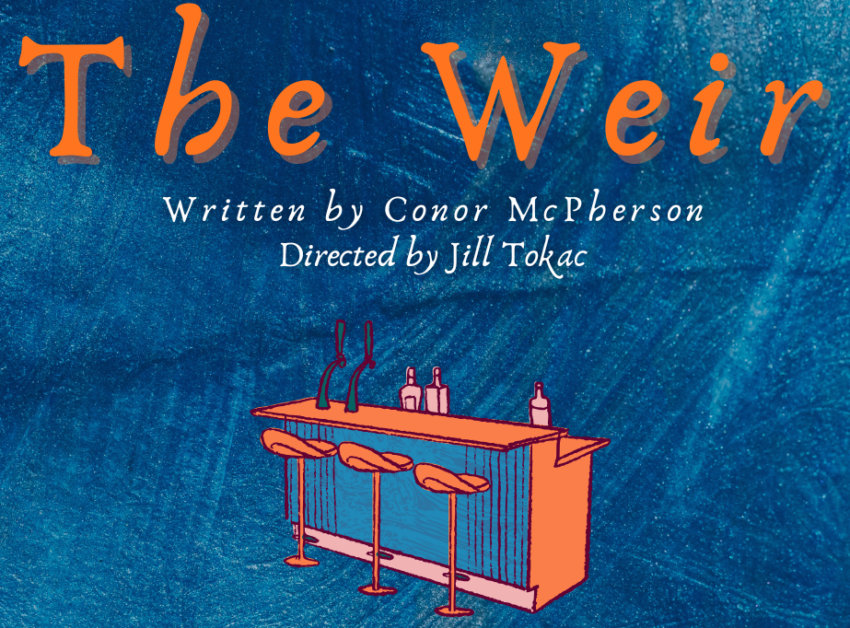
‘The Weir’ by Connor McPherson.Directed by Jill Tokac. Stage Management from Carlisle Robbins.Scenic Design by Chris Albrecht. Set painting from Sinead Bergeron. Lighting Consultancy by Travis Burt. Production Support from Lizzy Pease, Alana Corrigan, and HCE Player’s Board. Here Comes Everybody Players‘ ‘The Weir’ runs from April 10th – 12th at The Foundry, 101 Rogers St, Cambridge, MA 02142.
By Charlotte Snow
Here Comes Everybody Players are making their grand revival and kicking off a new era of theatrical events with a fully staged production of Connor McPherson’s The Weir.
The play follows four male denizens of a pub in the Irish countryside swapping stories of the supernatural. These tales are told in effort to woo Valerie, a young woman who has just moved from Dublin. However, the timbre of the conversation darkens when she shares the reason for her sudden arrival.
The script, which has the potential to be a rousing collection of stories, fails on every conceivable level. While there are some moments of connection and witty banter between the five actors, there aren’t enough to keep this play moving in a meaningful direction. The scenes between the stories quickly begin to feel like filler, and the stories are too long and too often lacking the punch that horror requires. There simply aren’t enough insights into Irish culture, history, or pathos to walk away with any deeper understanding.
The casual misogyny around the character of Valerie was truly insufferable and went completely unaddressed. Rarely does a scene pass without the men ogling her or handling her with special kid gloves. Additionally, the script itself is underhandedly sexist. McPherson fills in Valerie’s tragic backstory with the well-worn cliche of being a young mother who loses her child in an accident. Why couldn’t she have had a run in with the supernatural without the baggage of motherhood, just like her male counterparts? And why does it take her suffering for the men to finally lay off her?
Here Comes Everybody’s script selection of The Weir baffles me, especially when considering the wide range of Irish playwrights out there, including: Marina Carr, Martin McDonagh, Edna Walsh, Brian Friel, J.M. Synge, Oscar Wilde, George Bernard Shaw, Samuel Beckett, W.B. Yeats, etc.
All five actors are faced with the two great challenges of being largely responsible for the storytelling and rarely being able to leave the stage. Derry Woodhouse’s Jack, the curmudgeon with a heart of gold, and Matty Finn’s Jim, a plain-spoken man with a deep well of empathy, shine in this quintet. Both portrayals feel deeply authentic and well lived in. Bradley Belanger’s Brendan, Noah Braunstein’s Finbar, and Julia Hertzberg’s Valerie, all put in admirable attempts with the material given, but never quite reach the ease and naturalness of their co-stars.
While I admire director Jill Tokac for letting the playwright’s words speak for themselves, the stretches between a change in stage picture were agonizingly long. It felt as though the actors were left abandoned onstage. Additionally, the decision to seat the audience so close to the action impeded on the actors’ ability to move around and properly play.
Some of the technical elements proved to be more distracting than immersive. Set designer, Chris Albrecht, and set painter, Sinead Bergeron, were not on the same page. Albrecht’s set dressing and furniture grounded the play in authenticity, even if the walls were too sparsely for any Irish pub. Bergeron’s scenic painting was uninspired and clashed with the realism of Albrecht’s scenic design. The baseline of the lighting design was also way too bright for any Irish pub. The lights continued to distract during key introductory stories. Large pools of blue and green flooded the stage making it impossible to focus on the actor’s faces.
These may seem like nitpicky details but, when overlooked, they completely undermine the intent of the production. Instead of being fully immersed in a countryside Irish pub, I was left asking “what kind of countryside Irish pub is this?” It’s especially unfortunate, given that this was a unit set and no other location was explored.
While it’s clear that a lot of hard work went into this process, particularly from the actors, I could not fully enjoy Here Comes Everybody’s production of The Weir. I applaud any indie theatre company devoted to culturally specific work, but as a revival and grand return to fully staged work, they did not put their best foot forward.