
Photos by Ollie Kamens
By Kilian Melloy
Liars and Believers devises its shows using a collaborative process. Its shows are lively and inspired, combining various theatrical traditions in works like Yellow Bird Chase, a favorite that tours to enthusiastic audiences. But the company doesn’t create fun fluff; behind the clowning, bright design work, and physical comedy are artistic director Jason Slavick’s creative and philosophical concerns. “I have political and social goals,” Slavick admits. “Actually, everything I do has some deep intention, even Yellow Bird.”
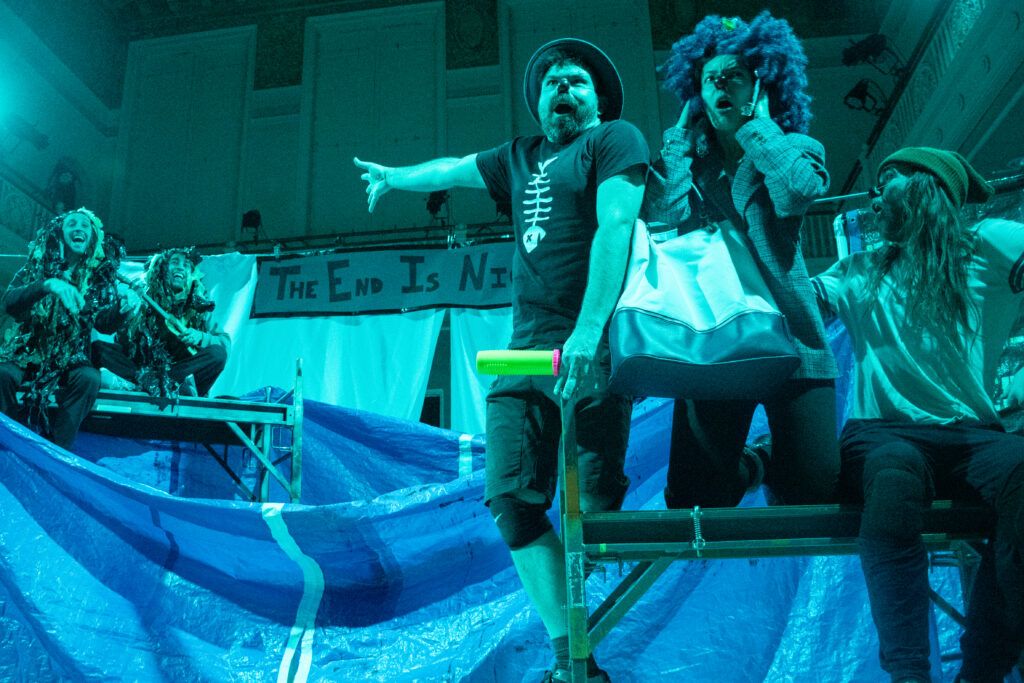
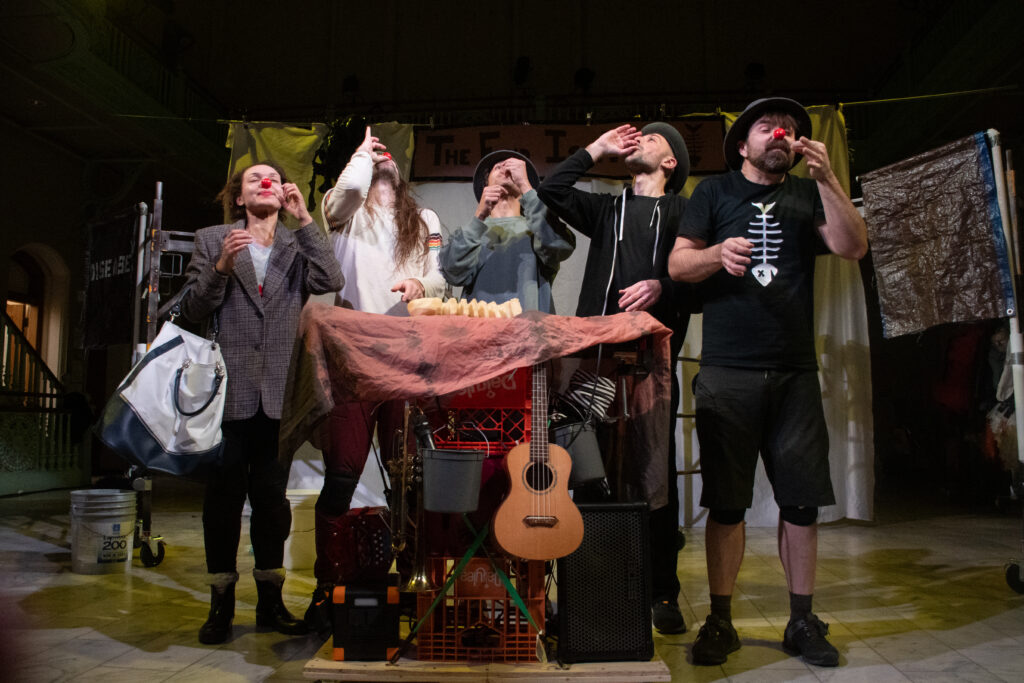
You’d be hard-pressed, even with the rough-and-tumble mania of LAB’s latest show, The End is Nigh, to miss the point Slavick and company are making. Presented as a brutal game show that plays like a cross between The Running Man and the Apocalypse, The End is Nigh pits contestants against each other in a death match set against a burned-out planet’s fading final days. The blood sport is vicious… or, it’s supposed to be; but what if the contestants that the show’s host and helpers are trying to set against each other refuse to lapse into othering and rivalry and choose cooperation and empathy instead? The result is a ray of hope that cuts through the miasma of hatred and despair. LAB describes the show as “Animaniacs meets The Hunger Games,” but the focus is on the fracas, and you won’t be starved for laughs.
Slavick, together with Liars and Believers Executive Producer Georgia Lyman, chatted with Theater Mirror about the show, what it means, and why it matters.
Kilian Melloy: The End is Nigh makes me think of Yellow Bird Chase, but with teeth.
Georgia Lyman: It’s a funny story, actually. I commissioned Yellow Bird Chase from Jason when I was working on Ted Cutler’s festival, Outside the Box, years ago. I had seen a lot of Jason’s work, and I was like, “I need somebody who can do a trunk show.” We’ve been touring it ever since.
Kilian Melloy: You developed The End is Nigh as an ensemble. Does everyone have an equal say? Or do you have to do things by consensus?
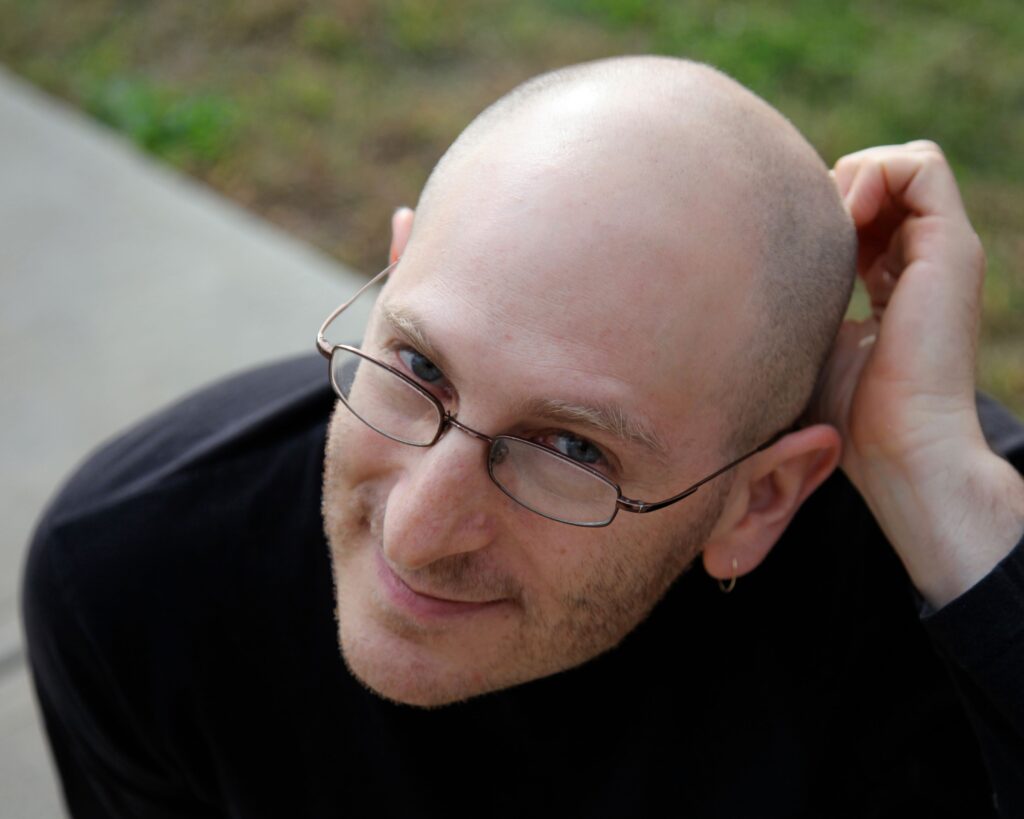
Jason Slavick: I’ll approach the company, saying, “I’m thinking about this,” and we get to a point where we all agree this is going to be our next show. With that, I provide the first prompt, and we think about what we’re going to be doing and how many actors we want. The first thing we do is cast, before there’s a script at all. Once we have our performance ensemble, I’ll ask, “What is the end of the world? What are you thinking about?” I use large butcher paper, and I tape it up on the wall, and as they’re talking, I’m taking notes, so they get a visual representation of what we’re going toward.
I take all that content and I look for patterns. What are we doing? What are the forms that are coming out? What really sticks? We work for three weeks, and then I edit, then we come back later, and we do a process like that again. I do everything in my power to free their creativity so they can spew stuff and let their imagination just go, and I’m doing all the editing and watching. I take the censor out in every way I can, and they don’t have to make sense [or] decide, “Is this good or is this bad?” That’s our process. Nothing we do [in the show] is improvised.
Kilian Melloy: Georgia, what is your role in all this?
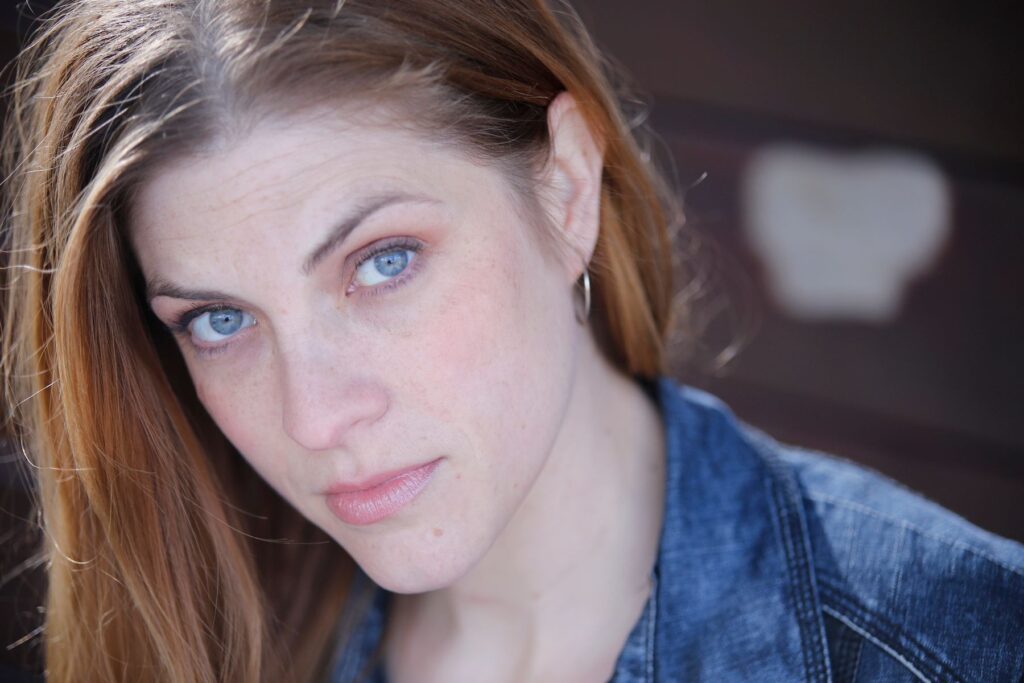
Georgia Lyman: Everything else. My role is to function as admin, all of the boring stuff to help keep the company on track. Jason and I have been having this conversation a lot lately because we’ve got a couple of big-picture things that are happening simultaneously while we’re moving into production mode for this show. I can take care of everything else and keep that rolling so that it allows him to function as the main creative engine for the in-the-moment stuff.
I like to think that I can serve as an outside eye, because I’m not in rehearsals all the time. I can come in and go, “What’s going on here? I’m not seeing how this puts together. Tell me how this is going to relate to the other thing.” I try and serve as a creative sounding board to make sure that the story that Jason is telling is clear to somebody coming in from the outside. Sometimes it’s useful to have an outside [perspective] on it.
Kilian Melloy: There’s still going to be production elements like lighting and sound design, props and costumes, not to mention the performances. Somebody has to guide and direct all this.
Jason Slavick: Again, that would be mostly me. There’s a lighting designer, there’s a costume designer, etc, and Becca, who is our senior designer, is looking at the overall aesthetic world, but we kind of share the roles between Becca, Georgia, and me. One thing that has made us successful is staying really lean.
Georgia Lyman: A mom-and-pop shop. A right-brain/left-brain operation.
Kilian Melloy: You’ve described the show as Animaniacs meets The Hunger Games — it’s loaded with cartoon violence and physical comedy. How do you find the humor in the existential threats we face?
Jason Slavick: Clown and physical theater give permission for a playfulness and allow you to get closer to things that would be a lot harder in realism. The impulse to make this play really came out of despair. The only thing to do is laugh about it. In the process, that evolved from a cynical laughing, as in ‘we’re all going down the drain’, into a path toward hopefulness. When you code things as cartoon violence, or as cartoon logic, it’s language that most people in our culture know, having grown up on those things. As an artist, and also as an audience, it lets your guard down, and then you can get closer to a thing, and you’re laughing at the thing — but you know the real thing behind it. I like to use comedy like that to let you in the door, let you get close to a thing, then transform it into the serious thing and grapple with it. And I like to end my plays with a question and a hope, because I don’t have answers. I do feel like we’ve got to do something; that’s part of our responsibility as artists, to grapple with the world and go somewhere with it.
I think a lot about Brecht. If you think about The Good Woman of Szechuan, or even Three Penny Opera, it’s disturbing, and he doesn’t let you off the hook, [but] then he gives a hint. That, I think, is the best we can do as artists, because otherwise we get preachy.
Kilian Melloy: I was very interested in how you fold the environmental situation into the fabric of the play.
Jason Slavick: It’s a reality TV contest. Each [contest] is led by one of the four horsemen of the apocalypse. They are Disease, Famine, War, and this week’s special guest, Horseman of the Apocalypse, Ecological Disaster.
[Laughter]
Jason Slavick: Normally, when I make a show, I have the theater doors open because I want the play world to bleed out into the hall, and I try to extend it as far as I can. In this case, I want the theater doors closed, so when you open them, you are transported into a different space. The moment you walk through those doors, you know it is a bad place to be. It should sound bad and feel bad, like this is all falling apart. All through the beginning, we are indicating that the air is bad and that there is danger, etcetera. We’re creating the whole environment of a world that is suffering.
Kilian Melloy: Georgia, since you’re a producer, if somebody has to go out and find the fabric or decide on the color of what the water should look like, is that something that you would be doing?
Georgia Lyman: I like to say that I drive the clown car, but what that actually means is I provide the framework for the artists to do their best work. Becca is going to tell me what fabric she wants, and then I will purchase it for her. If we need to make lighting on stage, then I need to make sure that our lighting designer, PJ, has the resources to create that effect. It’s very much nuts and bolts, but it’s also anticipating what they’re going to need. I also give a lot of hugs and a lot of emotional hand-holding, because that’s part of it — making sure that everybody feels supported. It’s, like, part plumber, part mom, part purchasing order.
Kilian Melloy: The script has some amazing technical directions — for instance, what kind of lights to be using. I don’t know anything about lights, but it looked very impressive and very industrial.
Jason Slavick: We settled on “janky chic” for a description. We decided on a near-future apocalyptic world [and] said, “Okay, what are the things that would have survived in that?” Everything’s metal and plastic and worn, and we purposely have been sourcing crappy-looking stuff. Everything is dirty, and falling apart, and taped together. Sometimes we’re intentionally using duct tape, as opposed to gaff tape, which is black and disappears. We’re intentionally using stuff that you see. We were looking for the ugliest, jankiest-looking things we could find.
Kilian Melloy: Is that something that also helps you with economy of production?
Georgia Lyman: That’s definitely part of [it] — like, “What can we get away with for as cheap as possible?” But there’s also [an environmental] crash behind [the story], and it’s a conscious decision [to reflect that in the design]. It’s not just, “We have 100 bucks, let’s put on a show.” It’s a conscious experience decision with a lot of minds behind it. In this case, it also helps us keep our budget down, so it’s a win-win.
Kilian Melloy: When you’re looking at what you want to do and the materials and resources you have, what kinds of compromises do you tend to have to make?
Georgia Lyman: Sacrifice the artistic integrity is where I would land on that, quite frankly.
[Laughter]
Georgia Lyman: Yeah, funny, but also true. If it comes down to money, then the question is, “All right, what can we do with what we have?” It’s not just, “Oh, well, we’ll do without.” It’s, “Is there another way to do this? Is there a way to do this that will not sacrifice the aesthetic or the vision that Jason and the ensemble have come up with?” It adds to the collaborative nature when we have to think creatively about how to solve a budgetary or a resource problem.
Kilian Melloy: Are there artistic compromises in terms of what the cast might want? Like, if the guy playing the shark were to say, “My shark should be a soft-hearted romantic poet,” but you want him to be a former bodyguard for an oligarch?
Georgia Lyman: “My character just wouldn’t do that” is not something I can say I often hear in this process, quite frankly.
Jason Slavick: That is a balancing act I have to do as the director.
[Laughter]
Jason Slavick: My job is to create an environment where we are doing this together, and it’s not about me or my vision. It’s about the product. It’s my job to remember [that] you know things when you’re in [character] — things I don’t know — and your mind creating this character has a vision that I can’t have because I’m not inside you. On the other hand, it’s my job to shape all of it, and keep it all in line. I have to know what the story is we’re telling. Does this serve the story best? It’s not about what I like or what I believe; it’s being disciplined about looking at the question at hand. And then, finally, it’s not a collective. When a choice is going to be made, I will be the person making that choice. That is nuanced; we are devising together, we are collaborating, but I am the ultimate decider. Not everyone is okay with that, and that’s fine. There are plenty of people who don’t like the devising, don’t want to do it, aren’t good at it, are not interested. And there are plenty who want the authorial voice and want full control and want to say, “No, that’s not what I think.” You have to be able to function in between.
Kilian Melloy: Could you say something about what you might have next in production?
Georgia Lyman: We have a lot of large collaborations and projects that we’re excited to get going in the next year, including a full national tour of Yellow Bird. So, that’s kind of terrific.
“The End is Nigh” plays March 12-21 at The Foundry, 101 Rogers St, in Cambridge. All tickets are general seating “Pay-What-You-Can” from $5-$100. Tickets and information: www.liarsandbelievers.com/show/the-end-is-nigh