Initiated by the Huntington Theatre, the Ufot Family Cycle is a massive undertaking by the Boston theater community. Across nine plays and three generations, Mfoniso Udofia’s series examines both the intimate life of one family and the expansive reach of the African diaspora. The artistically and logistically complex effort began last season and is slated to conclude this season. This citywide collaborative undertaking will have given five of the nine plays their premieres by the time the theatrical epic reaches its conclusion.
The cycle tells the multi-generational story of the Ufot family, beginning in the 1970s when married couple Abasiama and Ukpong flee the Biafran War and head to the United States. There, they pursue their educational goals, but discover that with new opportunities come fresh choices, some of them unexpectedly difficult.
Subsequent generations see the stories of Disciple, a brilliant academic, and his daughter, Toyoima, who follows in his footsteps… perhaps a little too closely, by the lights of some who accuse her of plagiarizing her father’s work. That is the storyline for the milestone seventh play in the cycle, Lifted, which is being produced by Wellesley Repertory Theatre and is being performed at several Boston venues this month: the Footlight Club in Jamaica Plain (March 10, 12, and 14); the Huntington’s Maso Studio (March 24-28); and Wellesley College’s Diana Chapman Walsh Alumae Auditorium in Wellesley (March 29). For a glimpse at the plays produced thus far, click here.
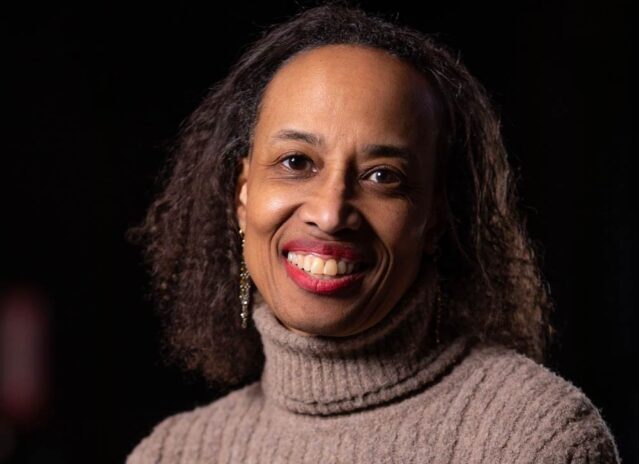
Undertaking dramaturgical duties for the Wellesley Rep production is Lois Roach, a writer, producer, and educator as well as dramaturg who has worked, like Udofia, in TV as well as stage productions. Roach took time to chat with QulturVultur recently, and to explain the duties of the dramaturg, unfold the complexities of the cycle’s narrative ambitions, and give a behind-the-scenes perspective on a play that’s still being fine-tuned.
Kilian Melloy: From what I know of the dramaturg’s art, it’s a matter of helping to contextualize a play and do research into what its setting and language. Is that a general description of the job, or does it vary from project to project and personal style to personal style?
Lois Roach: I can only speak to what I do with it. My background is a mix of producer and stage director. I’ve worked in television as well as in theater, and I also teach at Wellesley College and teach a class called Directing and Dramaturgy. There is a more academic approach, and there are actually dramaturgs who are Ph. D.s. I am not. I am one who works with mostly live playwrights, and therefore adapt what I do and my style to meet the moment and to me working with them. I’ve been working with new playwrights for over 30 years, and so when you’re in those settings, it’s always, “What? Why? What do you want me to know, see or feel, and why does that character only have one line?” That is my personal approach to the work, and when I work with students, those are the questions I want them to begin to think about as they create the work.
Kilian Melloy: Since you work with live playwrights, like Mfoniso Udofia in the current case, do you see your questions or maybe your suggestions showing up on the page as well as in terms of how the production is approached?
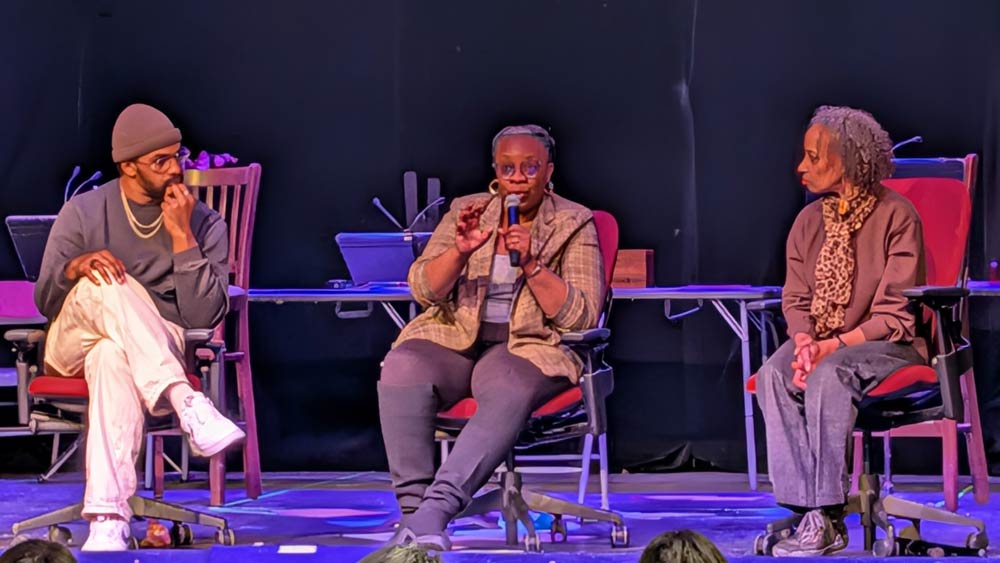
Lois Roach: It is not my role to write the play. What I teach in class is, “Why are these characters here? Who are they? How does the dialogue support what you want to do in telling the story?” It’s always about the questions. The biggest joy I have is working with students.
Kilian Melloy: Lifted is the seventh of a cycle of nine plays, and these are being produced between last season and the current season in partnership with various institutions around Boston. Does this also mean that you would be coordinating with other dramaturgs or other theater people who’ve worked on the other productions?
Lois Roach: In this instance, no. Wellesley Repertory Theater, which is the professional company of Wellesley’s theater studies program, is the producer for this workshop production. The other plays were already completed and published, and presented and produced in their published format. We’re making this up as we go.
Kilian Melloy: I had read that Lifted is a work in progress.
Lois Roach: It is a work in progress. Mfoniso is writing as many as 60 to 70 pages at a clip in making the changes, and so what is happening is that the actors are adjusting to the changes as we go through daily rehearsals. As the changes happen, both myself and Josiah [Davis], the director, are going, “Now it makes sense. Now I have more questions.” I’m going to keep coming back to your original question, which is, what is the role of a dramaturg? In this instance, because we are working day to day, I feel my role is a little bit more personalized, based on who I am, how I teach, and what my history has been.
Kilian Melloy: From what I understand, the social and familial issues for the whole cycle are complex, and in this case, the crux of the story is that the main character’s writings on traditional Nigerian lore lead to accusations of plagiarism. What sorts of cultural tensions come up when introducing a concept like plagiarism into an arena of traditional cultural knowledge? Can those concepts talk to each other?
Lois Roach: I’m going to break it down in this way: This is an academic who is applying for tenure, so part of what the play acknowledges is the rigors and practices that are part of that process. As you apply for tenure, what does that mean? Why does one want to put themselves through that process? Those are the questions that get asked in this play, so let’s start with the action of applying and going through the rigors of gaining tenure. Now let’s look at the content, and let’s look at the content of the thesis. Okay, so now, what is the goal of the thesis? What is it the heart of the thesis? I’m even going to throw out the word joy: What is the joy of the thesis? You would believe that someone going through that process loves the subject, loves the content, loves the story that they’re trying to tell, to get through 700 pages of material, if not more. In this instance, the main character is building off of material they grew up with, so the question here is: If it’s been emerged in your soul as long as it has been, then if you write of it, is that plagiarism? And if it’s based off of the work of your father, who lived in your house, whose papers you typed, who you helped organize, whose very existence is also in your body and therefore will seep into your body of work, is what you write and create really plagiarism? I’m going to give you one line from [the play]: “My blood is the proof.” Such a powerful line!
Kilian Melloy: That familial aspect makes sense for a play cycle that’s about a lineage and a family experience.
Lois Roach: All of the plays leading up to this have had some mention of Disciple, the main character’s father. Disciple was, in many instances, brilliant, and he was as brilliant as he was difficult. People who have seen the earlier plays have heard of Disciple, and they have known and felt the presence of Disciple. I will give you one other quote that I love, which is, “If we were well, would we be brilliant?” That’s one of my favorite quotes during this process.
Kilian Melloy: Is your first-hand experience in the academic world part of what you are bringing, also?
Lois Roach: We’ve had some conversations around the intricacies of the academic process. Oftentimes, people’s entrances and then their ability to maintain a presence within these institutions are wrought with their own challenges. Somebody might start off as a guest lecturer, become a visiting lecturer, and then have to leave because the institution says, “We only have visiting lecturers serve X amount of years.” Let me be fair to the institution: There is always the balance of, What are the politics of the time? What is the budget, and what are the needs of the various institutions and the departments within those institutions? So, that is my balanced way of presenting that information.
Kilian Melloy: The main character is shown from three different parts of her psyche by three different actors. I wonder what sort of research or thinking you’ve done around this, and if you referenced other plays that have done this — for example, Fun Home did a similar sort of thing with its main character.
Lois Roach: The way she has portrayed this, in my mind, is unique. To see the fracture of a Black woman become three different entities is something that is very new as a visual for me. I know it’s been done before, but as a Black woman sitting in this moment, A., she is brilliant, and B., it is enough of a realistic visual to make me go, “Wow,” and to look at it purely in the context of the moment. As we’re creating this work, it is very important for me, and all of us, to be present in the moment in rehearsal and watch these three actors physically grapple with being tethered. Though they are not tethered physically, they are tethered dramatically. To watch that being choreographed by our amazing director, Josiah Davis, and the actors — you’ve got to be present for that.
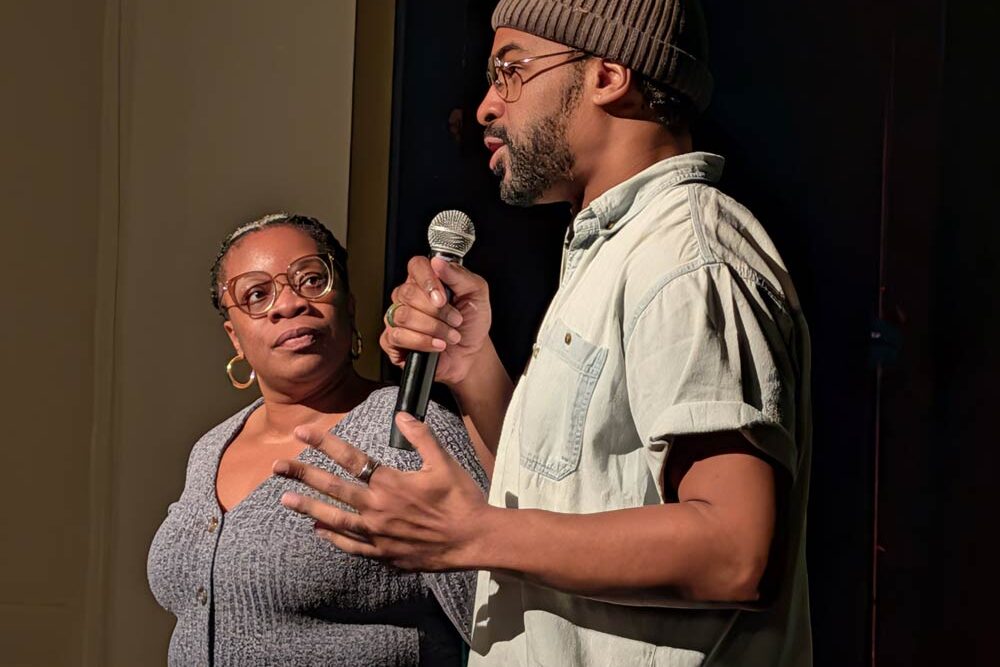
These three… forces, I will call them… one is front-facing, one is innocence, and the third is wrath. There are moments where each one impacts me differently, and there are some days that just plain wrath is delicious, because to be able, in the world that we are in right now, to have that force come out without the editing that must happen when front-facing and innocence and wrath are tethered together is brilliant, because somebody’s got to manage this balance of these three, and so to have that visually on stage is giving me goosebumps.
Kilian Melloy: What are you hoping audiences will discover when they come to see Lifted, and what do you want them to take away?
Lois Roach: I want them to understand the power of the personal. Mfoniso Udofia writes from such a personal and powerful place that makes her work authentic, unique, and, I repeat, brilliant. So, what I want people to witness as they see this work in progress are all of those elements.
This interview has been edited for length, flow, and clarity.
Upcoming performances of “Lifted” will take place at the Huntington Theatre’s Maso Studio at 264 Huntington Avenue in Boston, March 24 – 28, and at Diana Chapman Walsh Alumnae Auditorium at Ellesley College, 106 Central Street in Wellesley, on March 29. For more information and tickets, go to: Boston Theatre Scene