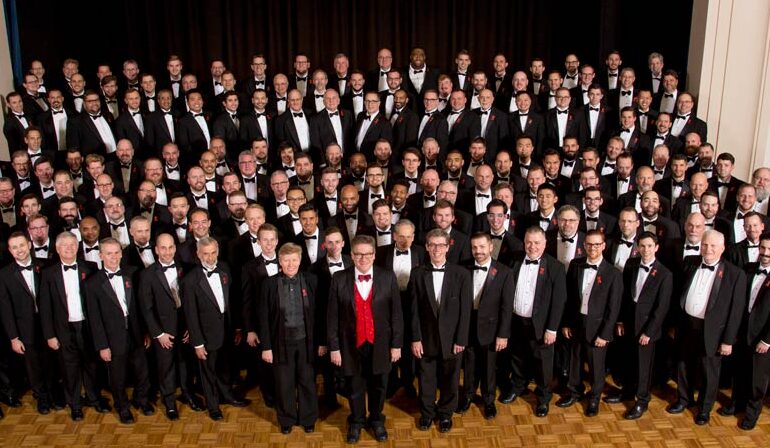
The Boston Gay Men’s Chorus has been making music and making change through music for the better part of a half-century. In that time, our community has seen victories and setbacks, from the depths of the AIDS crisis to growing representation and acceptance in popular culture, to judicial and political attacks, to the advent of marriage equality, and the current moment’s dismantling of access and protections for marginalized Americans of every sort.
“We talk about the mission of the Chorus being a three-legged stool,” Reynolds tells me on a recent Zoom call. “The first thing we do is create wonderful music. The second thing we do is create social change. The third is that we create a community for those people who really have no other communities.”
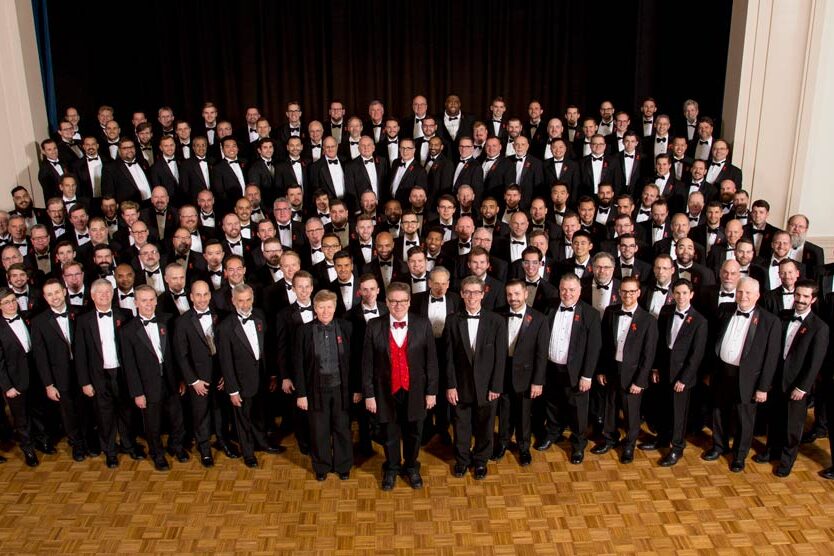
For decades, the Chorus served as a family for many of its singers. At its peak, the number of its singing members exceeded three hundred. Queer men of all sorts — gay, bi, trans — found that promised community. Straight men who wanted to sing and enjoy the fellowship of the Chorus were free to join as well; the doors were shut to no one. In recent years, the world seemed to be catching up to the Chorus’ ideals. Reynolds cited the longtime exclusion of LGBTQ+ people from Boston’s St. Patrick’s Day parade, a roadblock that finally fell away.
“Just yesterday, we had a quartet of our singers sing at the St Patrick’s Day breakfast down in Southie,” Reynolds noted. “Ten years ago, the Supreme Court stood said it was fine for them to ban gays. We fought that fight so that we could be part of it, and here we are singing at the St. Patrick’s Day breakfast, which I think shows you the strides we have made and the strides we must keep vigilant to protect. “The mission is to do more of what we’ve been doing for the last 45 years,” Reynolds summarizes.
[Full disclosure: I sang with the Chorus for nine seasons.]
Read on to hear what the longtime director of the BGMC had to say about the ongoing struggle for equality, the new challenges marginalized Americans face, and this weekend’s Spring concert, She Persisted, which celebrates iconic women trailblazers.
Kilian Melloy: How is the Chorus doing in these challenging times?
Reuben M. Reynolds III: It’s been tough, but we’re doing just fine. We’re still singing and still spreading our message, and that’s all that really matters.
Kilian Melloy: I imagine that the message must feel more important than ever.
Reuben M. Reynolds III: It feels like, in some ways, that the rights that we fought so hard for are being eroded, and it’s a shock that we have to stand up and fight for the same things again just to keep those rights. But it is kind of a wakeup call, too, and something that we address. One line in this concert coming up that really gets to me is [a] Ruth Bader Ginsburg [quote]: “I am ever hopeful that if the Supreme Court turns a blind eye today, in the future, its eyes may be opened.” That goes straight into Michelle Obama’s “I want a president who will teach my children that all people in these United States are equal.” That’s a message that I think we need to hear, considering everything that’s going on around us: That all people in this country are equal and need to be treated that way.
Kilian Melloy: It’s great that the chorus is dedicating a show to influential women with important messages. I don’t know that our community has always been the ally it should be to women.
Reuben M. Reynolds III: That’s an incredible word, “ally.” Even though we’re a group of men singing women’s voices, it’s because we want to ally ourselves. It comes under the heading of “We’re not free until we are all free.” If you think about the history of our relationship [with women], when AIDS hit, it was the women’s community that were the fundraisers, that took us to hospitals, that took care of us. We need to stand in solidarity with them as their rights are being attacked by this administration, just as our rights are being attacked.
The whole thing was brought about by this piece, Washington Women, which sets the words of everyone from Abigail Adams — I love her; “Do not put too much power into the hands of the husbands. Remember the women” — to, like I just said, Ruth Bader Ginsburg, Michelle Obama, Sandra Day O’Connor. We even look at Barbara Bush, who says, “Believe in something greater than yourself.” That’s exactly what we do when we come to Chorus rehearsal: We believe in something greater than ourselves, because the combined force of our voices, of all of us standing up there on stage singing together, is much more powerful than each of us saying it individually.
Kilian Melloy: Is this a piece that the Chorus has commissioned?
Reuben M. Reynolds III: Judith Clurman, who wrote this piece along with David Chase, wanted to write something that brought women’s voices to the forefront. It was written for men’s and women’s voices. I went to her and said, “Would you think about doing a version for us, just for men’s voices, so we could stand as allies together and sing those incredible words on the stage?” She thought about it for a second, and she said, “I would love to do that.”
We’ve been honored to work with Judith and David and take this piece on a long journey, and to realize that very often the people that we sometimes think badly of have said wonderful things and had great ideas that we can hold on to. It’s about finding the commonality of all people. We are all on a searching journey to find out what is right, and what is right is standing up for individual rights, and that’s what all of these women do. At the same time, we look at other women’s voices, everyone from Cher to Madonna [to Chappell Roan]. We have dancers in pink cowboy hats strutting their stuff to “Pink Pony Club.”
Kilian Melloy: I was going to ask you about the big dance numbers, because there have to be some.
Reuben M. Reynolds III: Of course, there have to be! “New Attitude” starts the concert, and Janet Jackson’s “Together Again” is a huge dance number. Many people don’t realize it was written by Janet Jackson about a friend of hers who died of AIDS. It is a song of remembrance, and it’s a song honoring all of those relationships we’ve had that are ended by tragedy, and how we can all look forward to being together again in the next life. It’s not just about dancing your booty off on the dance floor.
Kilian Melloy: This show will be at the Huntington Theater. Is this the first time the Chorus will be performing there?
Reuben M. Reynolds III: This is the first time at the Huntington Theater, and we’re very excited to start on this new road to develop a relationship between us. They’re building a huge new building next door, which will have lobby space for the Huntington. Our audience experience should be much, much better: Bigger seats, bars, restrooms that you can actually get to, and restaurants. You can make a whole evening of it. That will be open next year, but this year we’re getting our feet wet by getting in the door and singing in a new space.
Kilian Melloy: It sounds like this show is a mixture of serious and fun, as the March concerts tend to be.
Reuben M. Reynolds III: It is a huge mixture of serious and fun. I mean, Linda Perry’s “What’s Up?” Four Non-Blondes’ “Get Up Every Morning,” Madonna’s “Ray of Light,” Cher’s “Believe” — I love “Believe.” We have a new take on it; it’s no longer a huge dance number, but it’s modeled after Adam Lambert at the Kennedy Center Honors — and I say that as Kennedy Center — when he turned it into a slow ballad, and we were just amazed by that. It’s something we do with the Gay Men’s Chorus all the time: We take women’s songs and look at them in a different light, as they are being sung by men. How does that relate to our voices? “Believe” is a sterling example of that.
And then there is music that touches our souls. Emeli Sandé is a British female jazz singer who has written this incredible music where she talks about, “We have the words. We need to listen to it, and we need to not be afraid to stand up and say we are who we are, and there are brighter days coming.” Because even though it seems like oppression is happening now, as long as we stand up for ourselves, there will be brighter days.
Kilian Melloy: Speaking about the contributions of women, let me ask you about Michelle Chassé, the Chorus’s longtime choreographer, and ASL interpreter Lewana [Clark]. Will they be back for this?
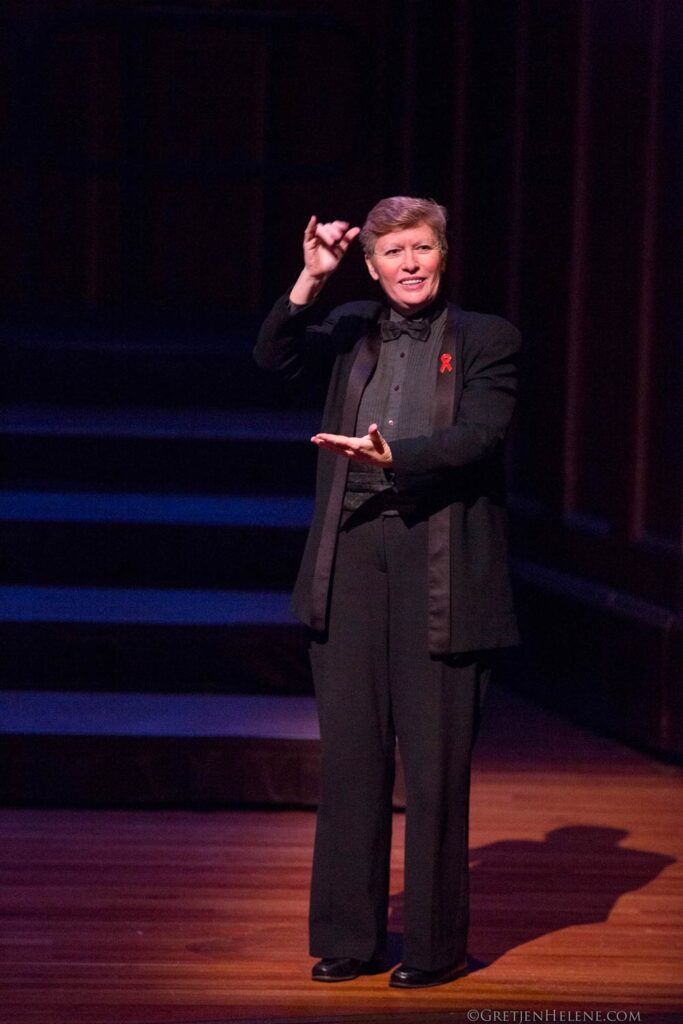
Reuben M. Reynolds III: Lewana will be doing ASL. And I just love that Lewana is the longest-time employee the Chorus has had. She is our touchstone in so many, many ways.
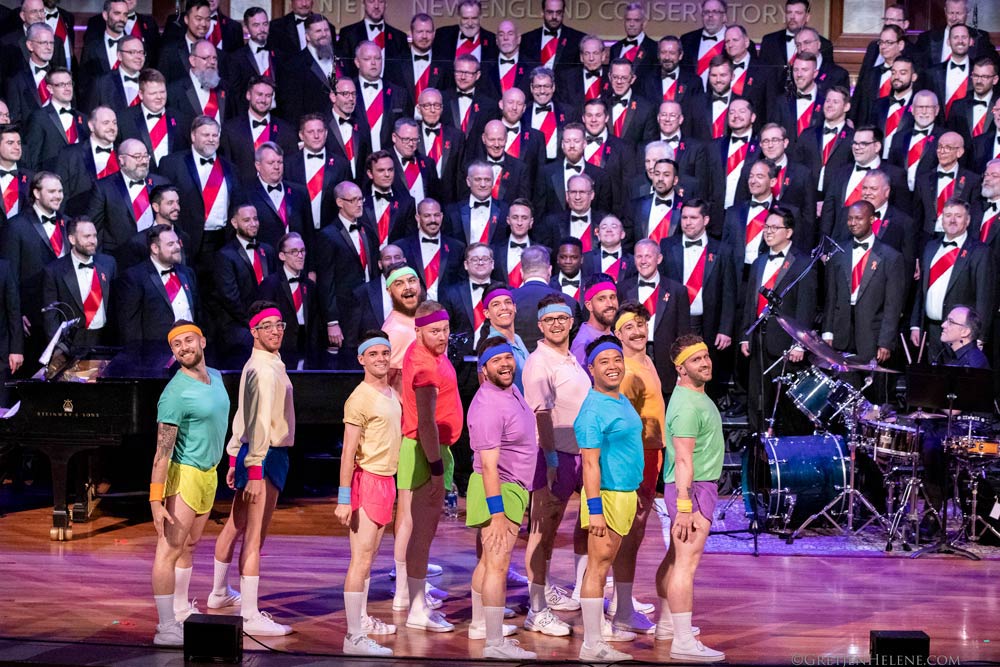
Michelle will not be doing this show because of a death in her family. She started rehearsals and did about a month of rehearsals, and then had to step away. But her assistant, Tommy Coyle, has taken over and is doing a wonderful job of twirling the dancers into shape. Michelle will be back for our next show, and we’re already planning next year, which is going to be — well, I’m not going to tell you, but it will be all dance and all froth and all fruit.Lots of costumes, let’s put it that way.
Kilian Melloy: Since we’re talking about the future, tell me about the June concert.
Reuben M. Reynolds III: The theme of it is “Rise.” We looked once again at what’s going on in the world, and it’s time for us to rise up in protest. We’re talking a little bit about the beginning of the gay rights movement, how Stonewall happened, and how the police would come in and raid bars. It’s kind of a story of a young man who leaves his hometown because of the gay bashing and oppression he’s struggled with and finds his own voice. I love this song, “The Times They Are Changing,” because times are changing. When people tell us we’re wrong and that we can’t be who we are, we must stand up against that. It’s a journey of acceptance, and we end the whole thing with a suite of songs about gay Pride — “I’m Coming Out,” you know, all the iconic gay anthems will show up in this concert. It honestly is a pride celebration.
As part of our Pride celebration this year, we’re singing for the first time with the Boston Pops, which is an incredible experience. Pride weekend, we will sing on Friday night at Symphony Hall with the Boston Pops and with Alex Newell, who has actually been our guest before. Then, on Saturday and Sunday, we perform our own Pride concert at Jordan Hall, and the following weekend, we’re at the Groton Music Center for a Pride concert. It’s a wonderful way to celebrate Pride.
This interview has been edited for length, flow, and clarity.
The Boston Gay Men’s Chorus presented “She Persisted” ran at the Huntington Theater in Boston on Saturday, March 21st, at 3 pm and 8 pm, and Sunday, March 22, at 3 pm.

I live in Perth Australia. Just wanted to thank you all for the enjoyment you give so many people. I love your music, energy and so lucky I found your on UTUBE.
Reuben I know you lost your partner and I hope you are happy and continuing to enjoy life.
THANK YOU FOR ALL YOU DO.
Yvette Corbett