Reviewed by Jamie Lin
The Sitayana (or “How to Make An Exit”) by Lavina Jadhwanil; directed by Tushar Mathew; scenic design by Jayoung Hong; lighting design by Ashley Ting Yung; costume design by Eric Tâm Tran. Presented by CHUANG Stage at the Boston Center for the Arts Black Box Theatre through October 31, 2026.
Setting aside the titular exit for a moment, it’s necessary to discuss the audience’s entrance into CHUANG Stage’s The Sitayana (or “How to Make an Exit”). The BCA Plaza lobby has been transformed into an array of color, Indian art, and a chhoti dukaan concession stand – a neighborhood minimart selling treats like masala munch and cardamom milk tea. A shrine to the late playwright, Lavina Jadhwani, anchors an audience engagement area. The art on display, commissioned by CHUANG Stage, is by local artists Pallavi Eswara and Geeta Jakkaraju to celebrate the many facets of Sita, the mythical woman embodied in Sitayana. Before you enter the theater, spot the sprawling scroll that gives a high-level summary of Ramayana, the Hindu epic this play upends. Many props and credit to lobby designers Jenny S. Lee and Bonny Chen for building a rich South Asian environment for audiences to step into before embracing the Sitas’ world.
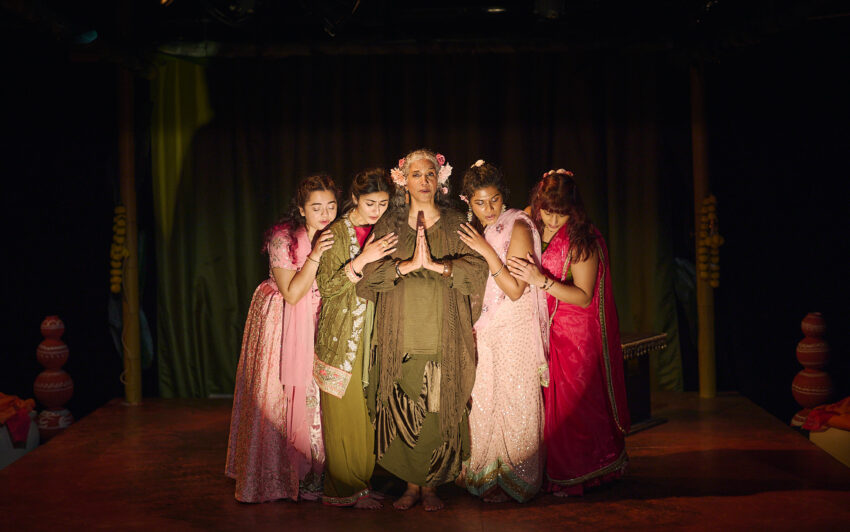
And now for the play: The Sitayana is a modern reimagining of the ancient Hindu epic, Ramayana, from the perspective of its hero, Sita. Five actors portray the legendary princess at various points throughout her life, from the age of 16 to 46. We open with the bombastic Sita 16 (Riya Ramaswamy), who swaggers in with teen confidence even as she announces: “I’m 16, and I’ve never been kissed.” With pluck and humor, 16 bemoans that her hand in marriage (let alone first kiss) is contingent on her father’s absurd challenge of stringing and breaking the celestial bow Pinaka. (It’s not unlike Penelope’s challenge in The Odyssey, nor is it the only parallel Sita will share with a mythical wife of another land.) The other Sitas take turns filling in the characters of her life: father, mother, sister, and suitors. Eventually, Prince Rama of Ayodhya struts in, winning Sita’s heart and the challenge.
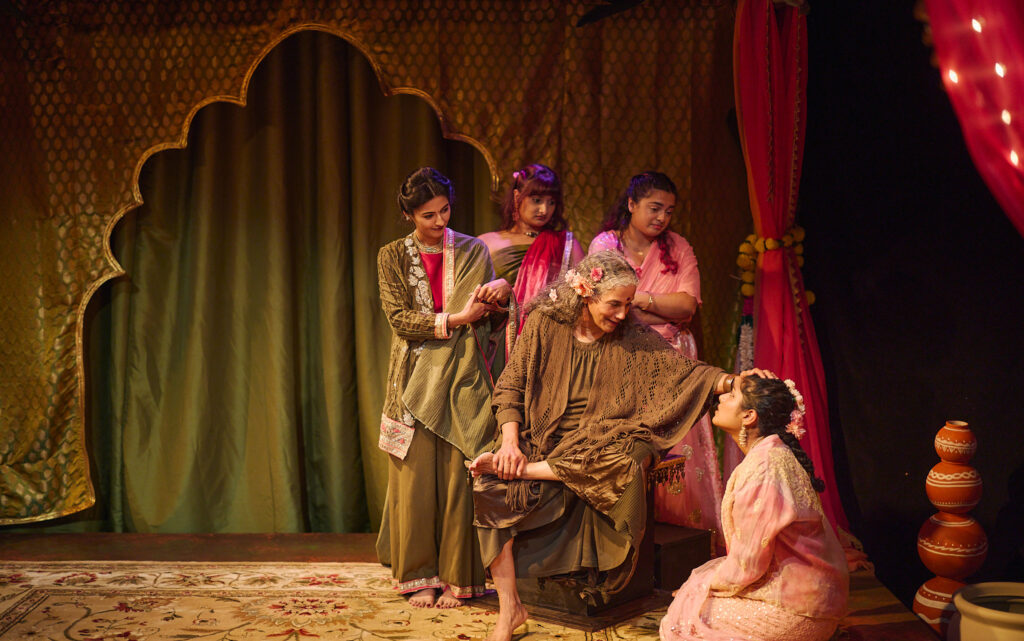
From there, each actor gets a moment in the spotlight, starting with Sita 18 (Audrey Seraphin), still girlish but maturing into her new royal duties. Later, Sita 20 (Vidisha Agarwalla), Sita 32 (Ann Varghese), and Sita 46 (Vijaya Sundaram) take over at other key points in her life, with Agarwalla and Varghese embodying the peaks of Sita’s joy and heartbreaks while Sundaram grounds her hard-won wisdom with gravitas and humor. Throughout, other Sitas are never far, often emphasizing key lines by swelling into a unified chorus. In one delightful moment, they echo Sita’s description of hearing “the crowd gasp” by looking pointedly at the audience until we do so. And in another, four of the Sitas menacingly push 20 to embody the multi-headed, multi-armed demon king Ravana.
Director Tushar Mathew has done a wonderful job coalescing this ensemble. The movement work throughout is fluid, dynamic, and purposeful. The five Sitas stalk as one unit just as easily as they spin out to create the chatter of gossipy laundry women or manifestations of Sita’s joy or despair. The set (by scenic designers Jayoung Hong and assistant Nell Lorimer) is a mandap, a pillared structure common in Hindu weddings, adorned with vibrant pink and orange curtains. As Sita peels away the layers of the narrative put on her, so too do the Sitas deconstruct the set, to stunning and resourceful effect. I was especially struck by the reveal of the “sacred fire” needed for Sita and Rama’s wedding ceremony.
Costumes by Eric Tâm Tran help to weave together Sita’s journey from the girlish baby pinks of Sita 16, to the richer pinks of 18 and 20, then the deep field green introduced with 20 and taking over more and more in Sita 32 then 46, who barely wears any pink at all. All five Sitas are dressed in Indian attire, but have a mix of traditional lehenga choli and salwar kameez to more contemporary styles, using their dupatta scarves to transition into the story’s masculine characters. The transitional choreography seemed to leave the dupattas dangling in unintentional moments, but the Sitas’ fluidity is smooth enough to ease these minor gaffes.
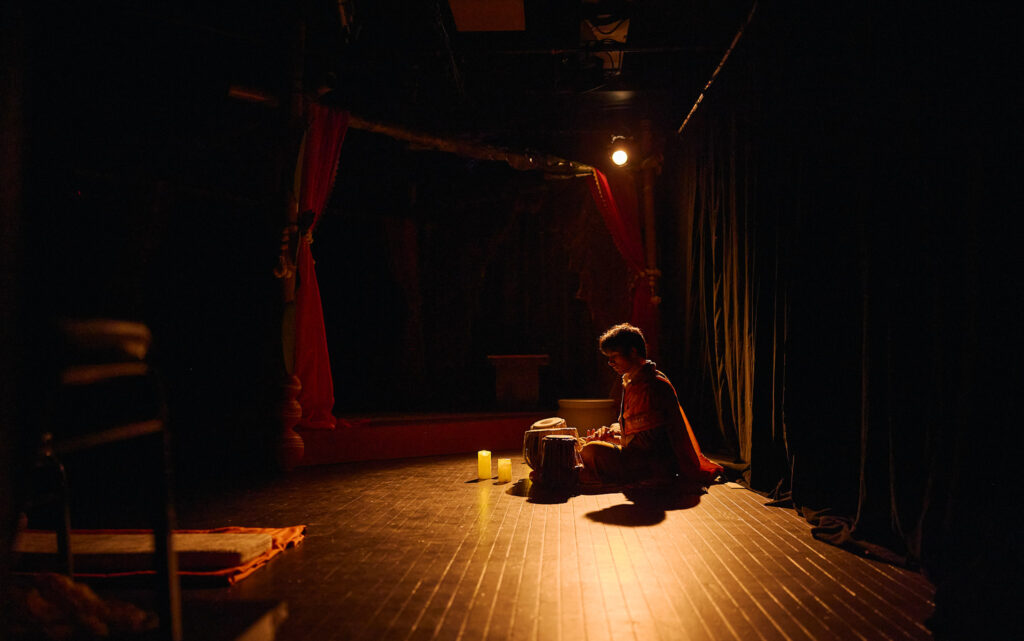
Lighting by Ashley Ting Yung fills the mandap on all sides and spotlights each Sita for key scenes. The downside of all the Sitas’ frequent movements is that they can leave both the hero Sita and her scene partners in relative darkness for certain moments, but these moments never last so long as to detract from the story. Underscoring the entire show is live tabla played by Om Hegde, a talented percussionist – his work during Sita’s Agni Pariksha (a trial by fire) was stunning.
The Sitayana (or “How to Make an Exit”) is a beautifully designed masterpiece of revisionist mythology, a tribute to the playwright’s history of spotlighting the work, patience, and invisible labor of women in building our stories and world. Sita gets to exit on her own terms. But don’t let this show exit Boston’s stage without you seeing just how she does it.
