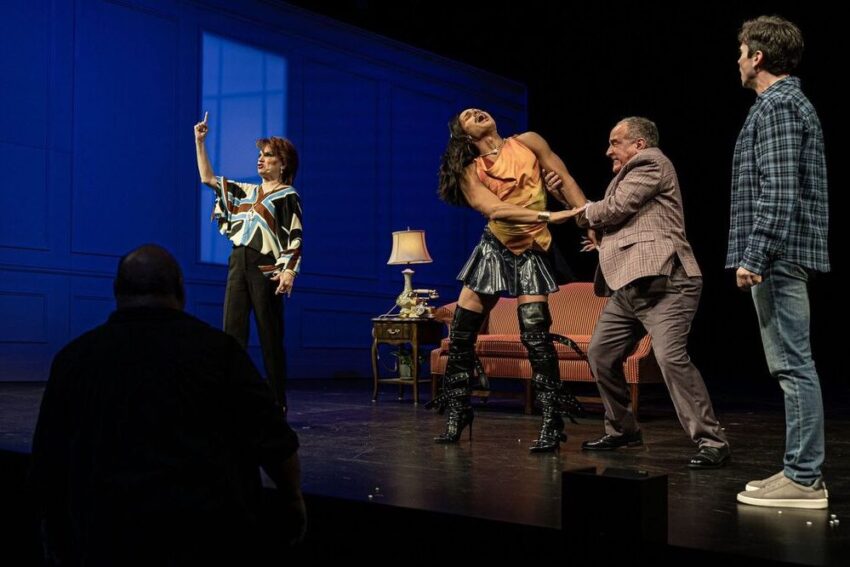
When Playwright’s Kill – Written by Matthew Lombardo; Directed by Noah Himmelstein; Set Design by Alexander Dodge; Costume Design by Alejo Vietti, Lighting Design by Elizabeth Harper, Sound Design and Original Music by John Gromada, Wigs And Hair Design by Charles LaPointe, and Illusion Design by Skylar Fox and Daniel Weissglass. Presented by Naughty Playwright, LLC at the Huntington Theatre, 264 Huntington Ave., through April 18, 2026
By Mike Hoban
“Must-See” is a grossly overused word in theater reviews these days, but if there’s a show this year that merits that mantle, it’s When Playwrights Kill, now playing at the Huntington. And if you were lucky/unlucky enough to have witnessed Tea at Five, the 2019 debacle that the play is based on (which also ran at the Huntington), you absolutely HAVE to see this play.
Playwright Matthew Lombardo exacts scathing (but hilarious) revenge on movie icon Faye Dunaway, who portrayed another Hollywood legend, Katharine Hepburn, in what was alleged to be a pre-Broadway run (and a return to Broadway for Dunaway after a 37-year absence) of his one-woman biographical play. The play mercifully closed after only three weeks, when Dunaway was fired from the production for abusing the Huntington staff. But what Lombardo has created is far more than a petty retribution vehicle for the destruction of his reworked (and frankly, still mediocre) play. Out of the ashes of that disastrous experience has emerged a terrific new comedy that simultaneously skewers the cynical process of Broadway playmaking and the industry itself. The playwright shies away from a direct connection to the real-life protagonist Dunaway, choosing instead to connect a rift between Mary Tyler Moore and Neil Simon−who unceremoniously fired her from an off-Broadway play of his for not remembering her lines−as the backdrop for the story.
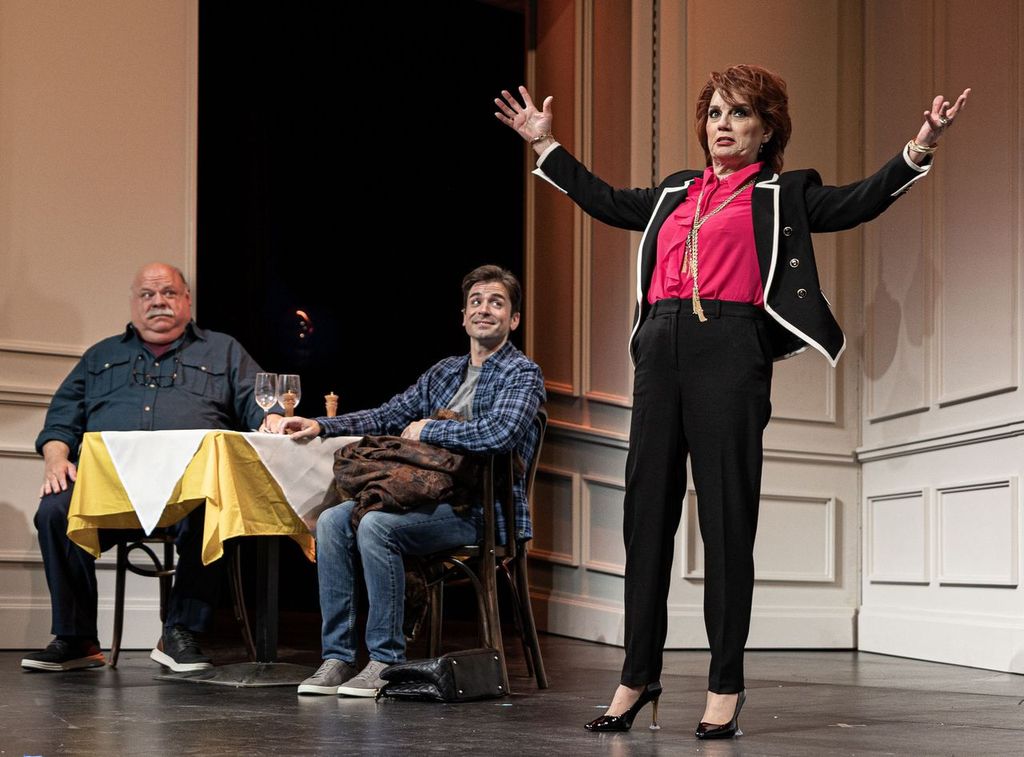
Here, long-suffering playwright (and narrator) Jack Hawkins (Matt Doyle) is finally getting his Big Break. Broadway producer Freddie Carlton (Adam Heller) has agreed to produce his play, perhaps for less than artistic reasons (“One set. One actor. Cheap to produce. LOVE IT!” he exclaims). Jack’s play, No Return, tells the story of Evelyn Parker, a fading movie star, blacklisted by Hollywood, and desperate to revive her career by returning to Broadway. With an eye towards box office sales, the producer and director (Kevin Chamberlin) agree that aging movie star Brooke Remington (Beth Leavel) should play the role−despite her reputation as a difficult personality and a stage history of not remembering her lines.
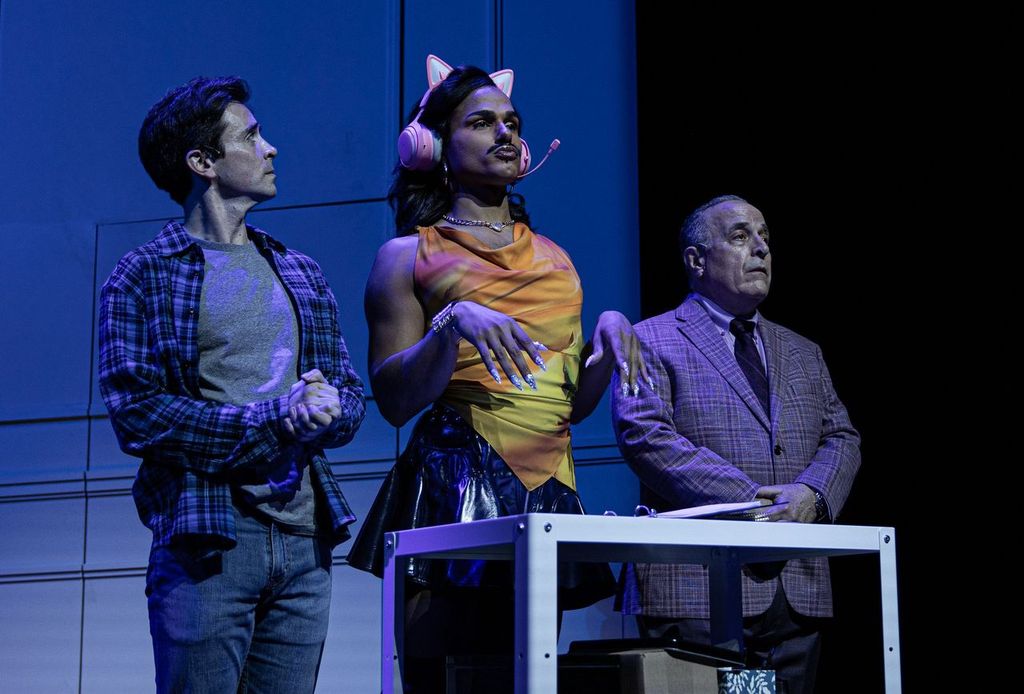
Over Jack’s protestations, Brooke is hired, and soon his worst fears are realized. Not only can she not remember her lines or stage directions, she’s also a Matthew Perry-level prescription pill addict, with a purse that doubles as her private pharmacy. But the show must go on, so the production team (including Marissa Jaret Winokur as stage manager Liz) provides her with a prompter (a riotous Tomás Matos) who will feed her lines through an earpiece. After a maddening rehearsal process, the show’s pre-Broadway run opens as scheduled in Boston and…the hilarity continues.
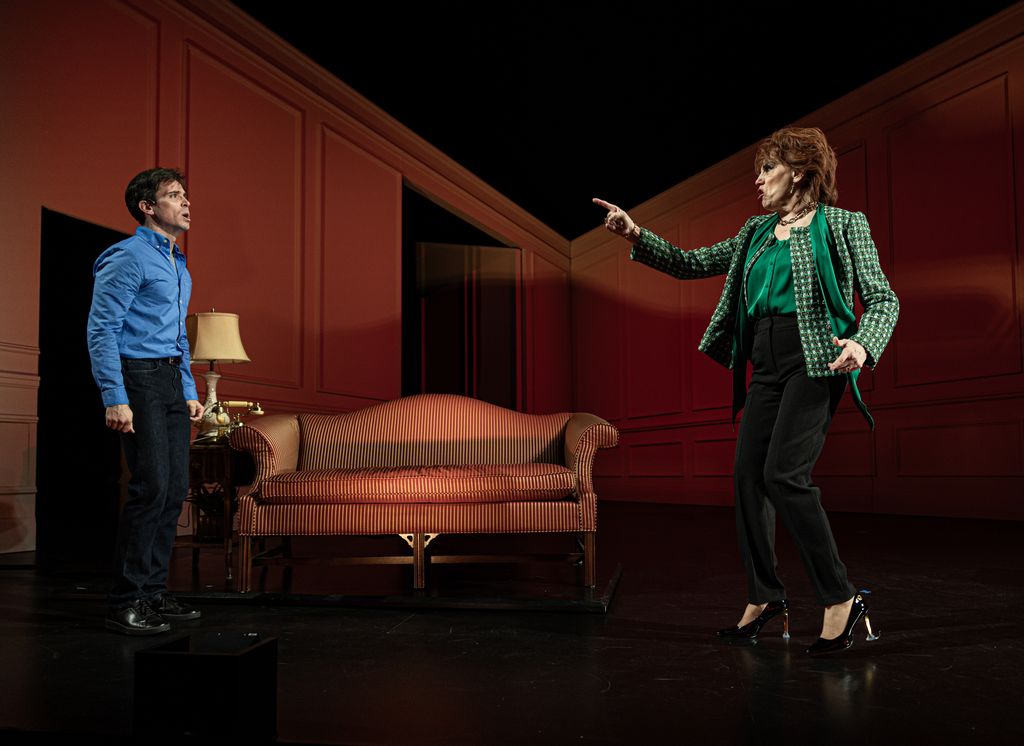
As funny as the play is, it’s also something of a love letter to a deeply flawed but sacred and lovable medium. One of its ugly truths is that Broadway—the industry’s pinnacle—is subject to the same compromises of any art that actually makes money: “the age-old struggle between the creatives and the financiers,” as Jack laments. Not that he’s above it himself, as he ponders the pros and cons of having his creation destroyed versus the payout that would let him escape a life of “pizza slices and Ramen noodles.” While the cynical pursuit of cash over art polluting Broadway receives its fair share of invective (“Back to the Future. Like, what the fuck was THAT??!”), even nonprofit theaters get their share of jibes. “No more slumming in regional theaters or in those God-awful 99-seat black boxes that smell like urinal mints,” Freddie tells Jack as he sells him on casting Brooke.
While Lombardo lampoons his industry, occasionally with a shot of vitriol, he also expresses his deep affection for theater through a handful of touching monologues that stand in stark contrast to the lightning-paced farcical comedy. It certainly helps that the cast is loaded with Broadway talent, including Tony Award winners Leavel, Doyle, and Winokur, who adroitly make the transition from raucous comedy to quiet drama and back seamlessly. Leavel is perfectly cast as the drug-addled diva Brooke, as are Heller and Chamberlin as producer and director. Doyle brings superb comic timing and boundless energy to the role of Jack, but it’s Matos as the non-binary drug dealer Val Le’Emm, who steals every scene they’re in. (Kudos, too, to costume designer Alejo Vietti, whose outfits for Val are somewhere between sexy and preposterous). As Liz, Winokur isn’t given much to do, but she burns white hot in a scene where she unloads on Jack and playwrights in general.
Some of the comedy in Act II is a bit of a stretch, particularly when Jack plots Brooke’s demise through a series of theater-related murder scenarios (possibly as an homage to the Vincent Price/Diana Rigg movie, Theatre of Blood), but most of the bits work well. There’s also a hefty dose of inside baseball in the play, but not so much that non-theater folk won’t be able to enjoy the production.
Nearly seven years ago, Lombardo thought he was on his way to Broadway, but was (serendipitously) derailed by a diva. This time, he should be on his way there with a production that actually does merit a Broadway run. For more information and tickets, go to: https://www.whenplaywrightskillboston.com/